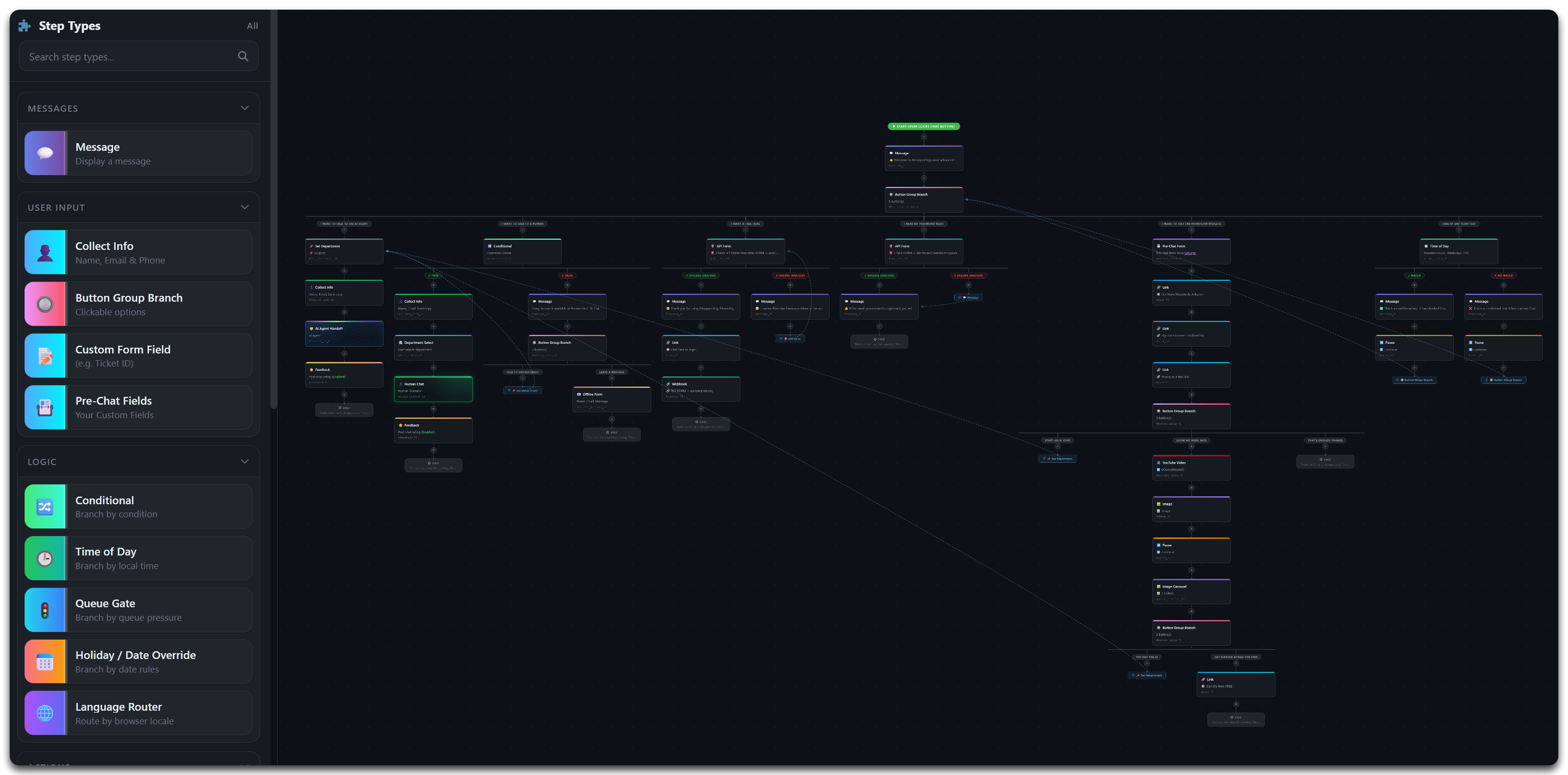
Drag, drop, and connect. Design chat journeys with AI triage, conditional branching, live API calls, webhook triggers, queue gates, and human handoff — all on a single visual canvas.
Traditional pre-chat forms are linear, inflexible, and lose visitors. The WorkflowChat visual builder replaces them with conversational journeys that adapt — routing on intent, querying your APIs, triggering webhooks, and handing off to AI or humans at exactly the right moment.
Every step appears as a natural chat bubble to the visitor. Behind the scenes, your workflow is executing conditional logic, making API calls, posting to your CRM, and routing to the right team — all transparently and in real time.
Drag any of these nodes onto the canvas and connect them. Build workflows of any complexity — from a simple FAQ triage to a 40-node enterprise support automation.
Deliver a message and wait for the visitor to explicitly acknowledge before the workflow advances. Essential for consent steps, policy displays, and instructional moments.
Capture name, email, phone, ticket IDs, order numbers, account references, or any custom field conversationally — no cold form. Captured data flows to subsequent nodes and API payloads automatically.
Present the visitor with distinct options — Support, Billing, Sales, Onboarding, Retention — and route each to a completely independent workflow branch tailored to that intent path.
Query your own API mid-conversation. Branch true or false based on the response data — check order status, verify account credentials, look up ticket states, or validate any business data before routing onward.
Automatically route visitors based on your configured timezone, office hours schedule, and custom date overrides for bank holidays, closures, or seasonal events. Switch between live, AI, and offline capture silently.
Monitor live operator availability and queue depth. If thresholds are exceeded during peak periods, reroute overflow to AI-assisted paths or offline message capture — protecting service levels without dropping visitors.
Hand the conversation to the RAG-powered AI agent at any workflow stage. All captured context travels with the handoff — the AI answers from your knowledge documents without the visitor repeating any information.
Route complex, sensitive, or high-value conversations to a human agent. The operator receives the full workflow transcript and all captured data before typing their first message — zero repetition, immediate effectiveness.
Capture visitor data conversationally then POST it to any external API endpoint. Create support tickets and return live confirmation IDs, register new accounts, push leads to CRM, or trigger any API-accessible action.
Send all workflow-captured data to any HTTP endpoint — your CRM, helpdesk, Slack, Discord, Zapier, Make, or any custom automation stack. Trigger real-time notifications, record creation, and downstream process automation from chat.
Detect or ask for visitor language and route to language-specific message tracks, department queues, and policy documents. Support multilingual audiences from a single workflow canvas without duplicating entire flows.
Let visitors choose their destination queue, or route silently when intent is already captured from previous nodes. Each department can have its own operator pool, AI configuration, SLA settings, and follow-on workflow branch.
Check live order status mid-conversation, recover abandoned baskets, push discount codes, and trigger checkout actions through API-connected workflow nodes — without leaving the chat journey.
Embed YouTube tutorials, product images, screenshot carousels, and GIFs directly into the conversational flow. Guide visitors through complex setups, product features, or support resolutions visually — without leaving chat.
Insert pre-chat policy acknowledgements, GDPR consent checkboxes, and compliance declarations at any workflow stage. Captured consent is logged with timestamp and visitor context — audit-ready from day one.
Capture post-chat ratings and free-text feedback through the workflow. View drop-off analytics per node, identify abandonment points, and continuously refine your chat journeys using real visitor behaviour data.
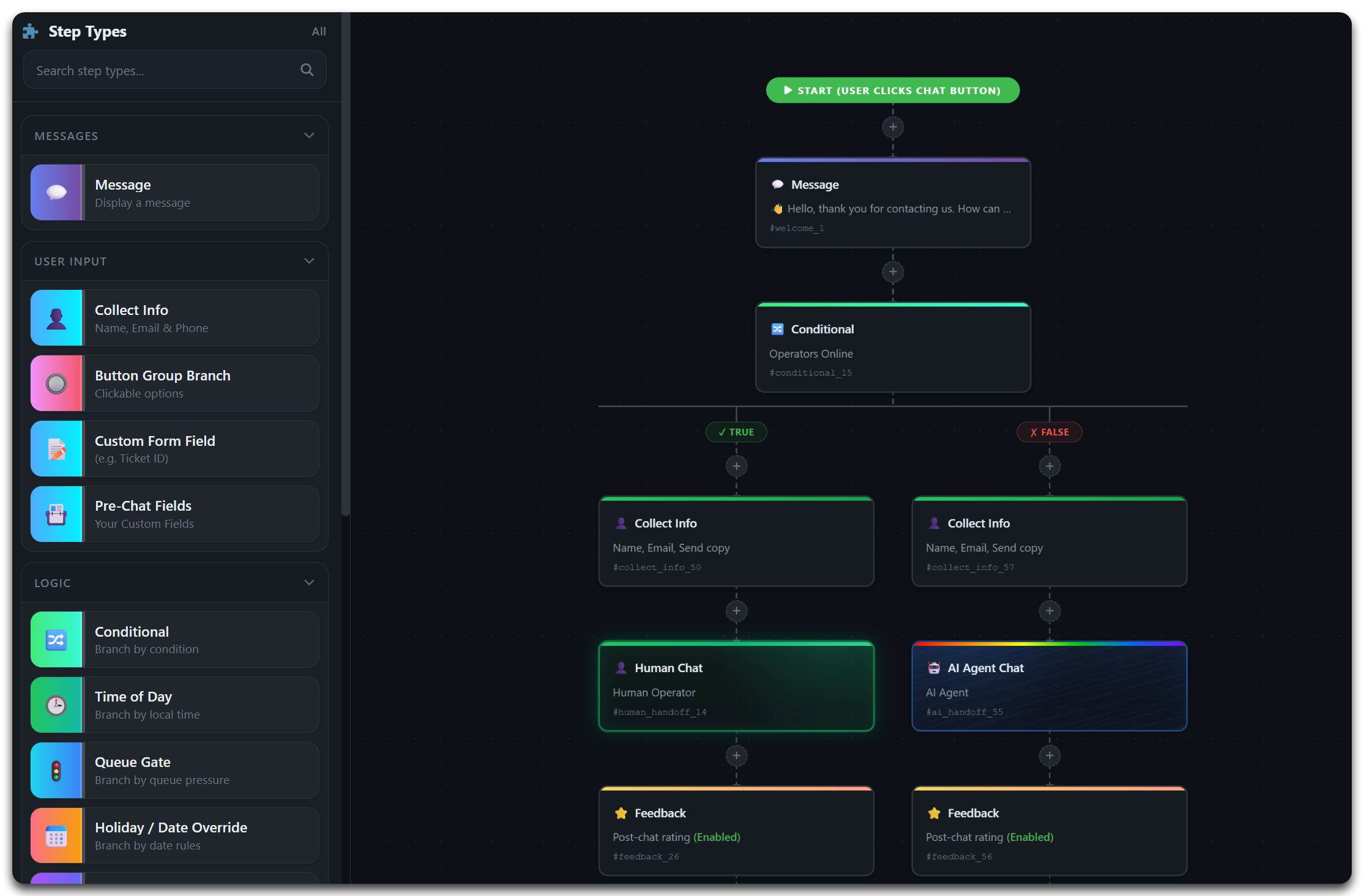
WorkflowChat's API and webhook nodes turn your chat canvas into a genuine integration layer. Query external systems mid-conversation, branch on live data, and trigger downstream processes — all without leaving the visitor flow.
WorkflowChat gives non-technical operations staff the visual tools to build complex automations, while giving developers the API depth to connect any system.
The workflow canvas is a free-form design space. Drag node blocks from the sidebar, connect them with lines, create parallel branches, and reorder the entire flow without touching configuration files. Operations teams build production-ready workflows independently.
The AI Handoff node connects to your RAG knowledge base — upload your own documents, FAQs, and product content. The AI answers from your verified content only, ensuring accurate and consistent responses. Update documents anytime for instant effect.
Track which paths visitors take through your workflow, where drop-offs occur, which nodes convert, and how handoff rates vary by department and time of day. Use data from every session to refine your flows continuously and improve first-contact resolution rates.
Create blocks once and reuse them across multiple workflows — your standard GDPR consent step, your opening hours gate, your primary intake form. Changes to a shared block propagate immediately to every workflow that references it. Design once, maintain in one place.
UK-hosted infrastructure with bank-level encryption. All workflow data, captured visitor information, and API credentials are stored exclusively in UK data centres. Role-based access for workflow editors, viewers, and administrators with complete audit trail of all configuration changes.
Paste one JavaScript snippet to deploy on any website — WordPress, Shopify, WooCommerce, Magento, Joomla, Drupal, or custom HTML. The Flow Widget renders natively on any platform. Mobile app access for operators on iOS and Android. REST API for programmatic workflow management.
Built for public services and private sector teams where accuracy, routing precision, and compliance matter as much as speed.
Automate service requests, route residents to the right team, and collect complete case details — reducing call centre volume for bins, planning, permits, and payments.
Triage non-emergency enquiries with decision trees, gather incident details via structured Collect Info steps, and escalate priority interactions immediately to operators.
Standardise legal intake with conflict checks, practice-area routing, and secure handoff to fee earners with fully briefed case notes — zero information loss between workflow and operator.
Capture suitability details, route clients by product type, and create FCA-aware contact journeys with full audit trails. API conditional branches validate account status before routing.
Handle bookings, check-in queries, concierge requests, and service escalations with department routing across reception, concierge, maintenance, and housekeeping queues.
Check basket status via API, recover abandoned carts, trigger discount logic, and route to sales agents for high-value order completions — all triggered from a single chat session.
Direct non-emergency enquiries, gather intake fields with Collect Info nodes, and route urgent paths to priority channels — with safe-messaging escalation built into the workflow.
Guide prospective students through course discovery, collect eligibility data, and route to admissions teams by programme — with webhook payloads posted directly to your CRM.
Qualify buyers, book test drives, and deliver structured lead data to CRM systems via API form nodes — while hot leads escalate to live sales teams via human handoff.
Destination-specific button branches, policy lookup via API, and multilingual language routing — covering booking support and customer service across time zones and languages.
Pre-screen candidates with structured Collect Info forms, branch by role fit, and trigger ATS-friendly webhook payloads — delivering structured candidate data without manual data entry.
Authenticate customers via API Conditional Branch, check outage or ticket status live, and escalate priority faults immediately — replacing phone queues with intelligent chat triage.
Route by location and time using Time of Day nodes, collect pickup details via Collect Info, and push structured dispatch data via webhooks to your routing systems in real time.
Route to nearest branch via department logic, handle stock checks through API Conditional Branch nodes, and switch overflow traffic to AI-assisted paths during peak periods via Queue Gates.
Automate FAQ deflection, internal request qualification, and cross-system workflow triggers at scale. API form nodes push directly to ITSM platforms — ServiceNow, Jira, and beyond.
Triage beneficiaries, volunteers, and donors through dedicated workflow branches that collect compliant data, satisfy safeguarding requirements, and route to the right coordinators.
Sign up in under 60 seconds. No payment required to start. You'll be taken directly to the WorkflowChat dashboard, where the visual canvas is ready and waiting on your first workflow.
Drag node blocks from the sidebar, connect them, configure branch logic, and wire up API endpoints or webhook URLs. Add AI handoff points, configure department queues, and preview the visitor experience in real time as you build.
Copy a single JavaScript snippet from the dashboard and paste it into your website footer — the same process as adding Google Analytics. Your workflow goes live immediately on every page where the snippet appears. Deploy at any hour; no release window required.
The traditional pre-chat form was designed in an era when live chat was a single-team email alternative. Today's support operations are multi-team, multi-channel, API-connected environments — and the pre-chat form's linear, one-size-fits-all structure serves none of them well. A form that asks "name, email, how can we help?" collects the same information from a customer checking an order status as it does from a developer debugging an API integration or a high-value enterprise client requesting an account review.
Branching workflow logic changes the fundamental equation. Instead of collecting the same information from everyone, a button group branch asks the visitor to identify their intent in two clicks, then routes them to an intake path specifically designed for that scenario. The order-check path queries your order API directly. The developer path surfaces technical documentation via the AI knowledge agent. The enterprise client path routes to a dedicated account manager's queue with a priority flag. The same canvas, three completely different experiences — each optimised for its audience and purpose.
The breakthrough capability of a modern workflow builder is the ability to connect the conversation to live business systems mid-session. Before intelligent workflow tools, the chat agent was an isolated channel — it could collect information from customers and pass it to a human, but it couldn't independently look up data, create records, or trigger downstream actions. That separation introduced delays, inaccuracies, and unnecessary human touchpoints.
With API Conditional Branch nodes, an enquiry about an order status no longer requires a human to look it up. The workflow queries your API, receives the status data, and branches accordingly — showing "in transit" with tracking details if the order is shipped, or routing to a human agent if the order is flagged as problematic. With Webhook nodes, the end of a successful intake flow immediately creates a CRM record, posts a Slack notification to the assigned team channel, and opens a helpdesk ticket — all before any human has read the conversation. The chat workflow becomes a genuine process automation layer, not merely a contact collection tool.
One of the highest-friction experiences in digital support is reaching a chat widget outside business hours, entering detailed information about a problem, and receiving a "we're offline, please email us" response after five minutes of typing. The visitor has invested time and received nothing. They are likely to abandon and unlikely to return. Time-of-day and queue-pressure routing nodes eliminate this failure mode entirely.
A properly configured workflow detects that it is 10 PM on a Sunday and routes the visitor immediately to an AI-assisted path — where the RAG knowledge agent handles the majority of queries using your verified documentation, and a structured intake form captures contact details and case notes for human review the next morning. If a queue gate detects that Monday morning has brought a surge in volume and the live queue has exceeded its threshold, it silently reroutes overflow to the AI path rather than lengthening the wait time. The visitor gets an answer either way. The human team gets a manageable, prioritised queue. Service levels are maintained without additional headcount.
Deploying a workflow is not the end of the process — it is the beginning of a continuous improvement loop. Workflow path analytics show, for every session, exactly which branches visitors took, where they dropped off, where they requested human handoff, and how long each node held their attention. This data reveals the gaps that traditional chat transcripts do not.
A high drop-off rate at a particular Message node suggests the copy needs updating. A consistently high human handoff rate from the AI section of a branch suggests the knowledge base is missing a key document. A queue gate that activates every day between 9 AM and 11 AM suggests a staffing gap that can be resolved with a staggered shift start. The workflow builder creates a feedback loop between visitor behaviour and operational design — transforming support chat from a reactive cost centre into a measurably optimised customer experience function that continuously gets better with every deployment cycle.
No credit card required. Access the full visual canvas, all 15+ node types, AI handoff, API and webhook integration — free to build, free to test.
Full workflow canvas. No payment. Live in minutes.
Powered by IMSupporting. UK-hosted. GDPR-compliant. Cancel any time.
The visual workflow canvas, all node types, API integration, and webhook support are available from the Solo plan up — no tier-locking of core workflow features.
1 concurrent AI agent · 1 operator account
5 concurrent AI agents · 20 operators · +£14.99/extra
Tailored for large organisations
APU = AI Processing Unit. 1 APU ≈ one AI-assisted chat session. No hidden fees. Same price regardless of total chat volume.
No. The entire workflow builder is visual — drag node blocks onto the canvas, connect them with lines, and configure each node using a form-based interface. API endpoints and webhook URLs are entered in fields; no JSON or code editing is required. Developers can use the full REST API for programmatic workflow management if preferred.
Yes. The API Form node POSTs captured visitor data to any external endpoint and can display templated response data back to the visitor. The API Conditional Branch node queries your API and branches the workflow true/false based on the JSON response — enabling live order lookups, account checks, ticket status queries, and any API-accessible business logic.
The Webhook node sends a structured JSON payload containing all workflow-captured data to any HTTP endpoint you configure. This triggers downstream actions immediately — CRM record creation, helpdesk ticket opening, Slack notifications, Zapier/Make automations, or custom business processes. There is no limit to the number of webhook nodes in a single workflow.
Yes. Use a Button Group Branch at the start to let visitors select their area — or use intent data already captured to route silently via Set Department. Each branch operates as a completely independent workflow path with its own node sequence, AI configuration, operator pool, and API integrations. Changes to one branch do not affect others.
The AI Handoff node passes the active conversation to the RAG-powered AI agent. All data captured in preceding Collect Info nodes is forwarded — the AI has full context and answers using your uploaded knowledge documents without the visitor repeating anything. If the AI cannot resolve the query, the Human Handoff node escalates to a live operator with the complete transcript pre-loaded.
Yes. The Time of Day and Holiday Override node routes visitors based on your configured hours, timezone, and custom date overrides. Outside office hours, the workflow can branch to AI-only paths, offline capture forms, or pre-recorded message sequences — ensuring visitors always receive a useful response regardless of when they arrive. Queue Gates add an additional layer for managing peak-hour overflow automatically.
Sign up free and start dragging your first nodes. Build something that does the work — so your team doesn't have to repeat it.